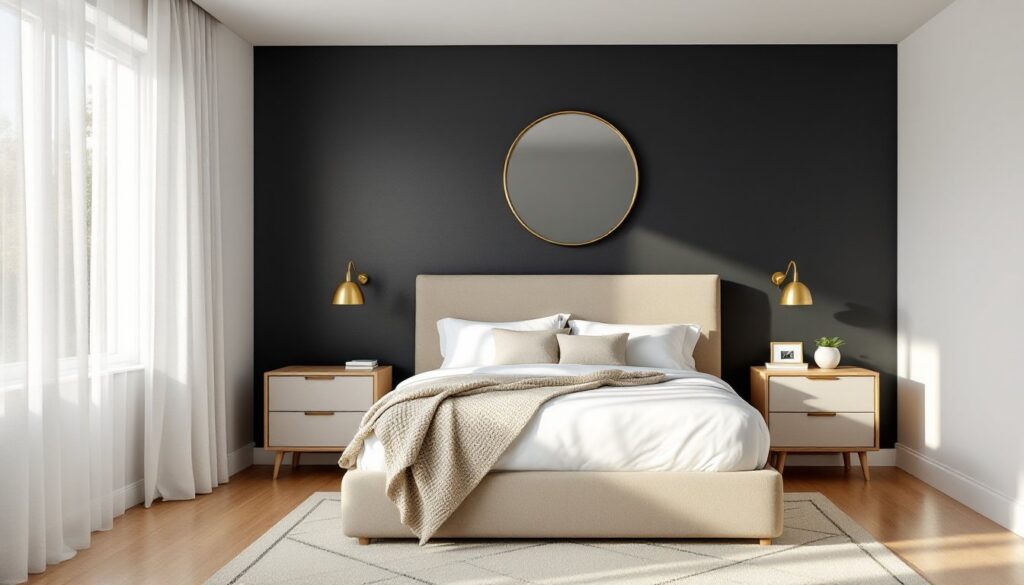

A black accent wall can anchor a bedroom with drama, depth, and sophistication, if it’s done right. Unlike neutral grays or beiges, black makes a commitment. It changes how light moves through the room, how furniture reads against the backdrop, and how color pops or recedes. Whether painting drywall, installing shiplap, or applying textured wallpaper, the prep work and finish selection matter as much as the color itself. This guide walks through placement strategies, material options, complementary palettes, and lighting fixes to ensure a black wall enhances the space instead of shrinking it.
Key Takeaways
- Black accent wall bedroom ideas work best when paired with intentional lighting design—use layered ambient, task, and accent lights at 15–20 lumens per square foot to prevent a cave-like effect.
- Position your black accent wall behind the headboard or on the longest uninterrupted wall to maximize visual impact and create a strong focal point without competing with windows or doors.
- Choose matte or eggshell finishes for durability near furniture, and always apply primer plus at least two coats of premium black paint to achieve true color without a washed-out appearance.
- Combine your black accent wall with warm neutrals, metallics, or jewel tones to add depth and sophistication—avoid all-cool color palettes unless aiming for an industrial aesthetic.
- Shiplap, board-and-batten, or peel-and-stick textured wallpaper can replace paint for a dimensioned look that suits various bedroom styles and works well for renters seeking non-permanent solutions.
Why Choose a Black Accent Wall for Your Bedroom?
Black creates visual weight. In a bedroom, that weight anchors furniture arrangements and directs focus. A black accent wall makes headboards, artwork, and textiles stand out by providing high contrast, white linens look crisper, metallic frames catch more light, and wood tones warm up instead of blending into beige.
Black also hides imperfections better than lighter shades. Minor drywall flaws, seams, and texture variations disappear under deep pigment, which reduces prep time compared to bright whites that highlight every ding. For renters or DIYers tackling older homes, this is a practical advantage.
That said, black absorbs light. In small rooms (under 120 square feet) or spaces with limited natural light, a full black wall can feel oppressive without deliberate lighting design. If the room lacks windows or has only one small fixture, consider limiting black to wainscoting height (32 to 36 inches) or using it on a partial wall behind the bed.
Black works especially well in bedrooms with high ceilings (9 feet or taller). The color brings the visual plane down, making cavernous spaces feel more intimate without closing them in. Pair it with white or light ceilings to maintain airiness above eye level.
Best Wall Placement for Maximum Impact
The wall behind the headboard is the default choice, and for good reason. It frames the bed, provides a clear focal point, and doesn’t interfere with closet doors, windows, or circulation paths. This placement works in almost any bedroom layout.
But the longest uninterrupted wall often makes a stronger statement. If the bedroom is narrow, painting the short wall at the far end can visually widen the space by drawing the eye across, not down the length. In rectangular rooms, this trick counteracts the bowling-alley effect.
Avoid walls with multiple windows or doors. Black emphasizes trim and casing, which means every window frame, baseboard, and door jamb becomes a design element. If the wall is chopped up by openings, the effect feels busy instead of bold. Exception: if you’re painting all trim in high-gloss white or metallic, the contrast can look intentional and architectural.
For rooms with sloped ceilings or accent architecture (exposed beams, brick, board-and-batten), black can highlight those features. Paint the wall that showcases the structure, not the one that hides it. Just make sure the ceiling height clears 7 feet 6 inches per IRC minimum, black on a low slope can feel claustrophobic.
In shared bedrooms or master suites with sitting areas, use black to zone the sleeping area. Paint the wall behind the bed and leave the sitting or dressing area lighter. This creates functional separation without needing a physical divider.
Black Accent Wall Paint Finishes and Materials
Matte vs. Gloss: Choosing the Right Finish
Matte (flat) black absorbs light and softens the wall. It’s forgiving on surface imperfections and creates a velvety, modern look. The downside: matte finishes scuff easily and can’t be scrubbed without leaving marks. Use eggshell or satin instead if the wall is near a bed frame, nightstand, or anywhere hands, pillows, or furniture might brush against it. These finishes offer light washability and a subtle sheen that still reads as matte from a distance.
Gloss and semi-gloss black reflect light and add dimension. They’re dramatic and work well in moody dark bedroom designs that lean into maximalism or Art Deco vibes. Gloss finishes amplify every flaw, though, dings, trowel marks, and drywall seams telegraph through the sheen. If the wall isn’t freshly skimmed or the studs weren’t shimmed level, stick with matte.
One gallon of premium black paint typically covers 350 to 400 square feet per coat. Black requires at least two coats over primer, sometimes three if painting over a light color. Skipping primer leads to uneven pigment and a washed-out charcoal instead of true black. Use a high-hide primer tinted gray to reduce the number of topcoats.
Wallpaper, Shiplap, and Alternative Textures
Peel-and-stick wallpaper in black patterns (geometric, floral, faux grasscloth) adds texture without the commitment of paint. Most peel-and-stick products apply directly to primed drywall and remove cleanly, ideal for renters. Match the pattern repeat carefully: misaligned seams are obvious on dark backgrounds.
Shiplap or tongue-and-groove paneling painted black introduces horizontal or vertical lines that elongate the wall. Use 1×6 or 1×8 pine boards (actual dimensions: 3/4″ × 5.5″ or 3/4″ × 7.25″). Install with a nickel-gap (1/8″ reveal) for a clean, modern look, or butt joints tight for a traditional feel. Shiplap is a cosmetic treatment, it doesn’t replace drywall or provide structural support. Attach boards to studs with 18-gauge brad nails and fill holes with wood filler before painting.
Board-and-batten in black creates a classic, architectural grid. Install 1×2 or 1×3 battens over a painted black base, spacing them evenly (16 to 24 inches on center works for most rooms). Paint the battens in contrasting white or the same black for a tonal, shadow-play effect. This is a weekend project, layout and spacing take longer than the actual installation.
For a high-end look without custom millwork, consider black acoustic panels or fabric-wrapped boards. These absorb sound, which is a bonus in bedrooms with hard flooring or high ceilings. Mount panels with construction adhesive or French cleats: avoid command strips, which fail under the weight of dense foam.
Pairing Your Black Wall with Bedroom Color Schemes
White and black is the safest, sharpest combo. Use crisp white bedding, trim, and ceiling to maximize contrast. This palette works in any style, Scandinavian, modern farmhouse, or minimalist. Add warmth with natural wood nightstands or a jute rug: without wood or texture, the room can read sterile.
Warm neutrals (camel, terracotta, ochre) soften black’s intensity. These tones bring in earthy, organic warmth without competing for attention. Pair a black wall with linen drapes in warm beige, rust-colored throw pillows, or a clay-colored accent chair. This palette suits Spanish, Southwestern, or mid-century modern bedrooms.
Jewel tones (emerald, sapphire, burgundy) lean into maximalism. Black amplifies saturated color, making velvet emerald pillows or a deep blue quilt look richer. This approach requires confidence, too many competing tones can feel chaotic. Limit the jewel palette to two or three colors and use them in large blocks (bedding, curtains, upholstered headboard), not scattered in small accessories.
Metallics (brass, gold, copper, chrome) pop against black. Swap builder-grade nickel hardware for aged brass drawer pulls or add a gold-framed mirror above the bed. Metallic finishes catch and reflect light, which helps offset black’s light-absorbing tendency. Balance is key, too much gold looks gaudy, but a few deliberate touches add sophistication that resonates with trends seen across interior design inspiration platforms.
Avoid all-cool palettes (grays, silvers, icy blues) unless aiming for an industrial or ultra-modern aesthetic. Without warm accents, these combinations can feel cold and uninviting in a bedroom.
Lighting Strategies to Balance Dark Walls
Black walls demand intentional lighting. A single overhead fixture won’t cut it, you’ll need layered light sources at multiple heights to avoid a cave effect.
Start with ambient lighting. A flush-mount or semi-flush ceiling fixture with LED bulbs at 2700K to 3000K (warm white) provides general illumination. Aim for 15 to 20 lumens per square foot in a bedroom. For a 12×12 room (144 square feet), that’s roughly 2,160 to 2,880 lumens total across all sources. Black walls absorb more light, so budget toward the higher end.
Add task lighting at the bedside. Swing-arm sconces mounted 24 to 30 inches above the mattress surface free up nightstand space and direct light exactly where it’s needed for reading. If wiring into the wall isn’t an option, plug-in sconces with hardwired-look cord covers work just as well. Choose fixtures with adjustable arms or shades to control glare.
Accent lighting highlights texture and adds depth. Picture lights over artwork, LED strip lighting behind a floating headboard, or an uplight in the corner washing the ceiling all create dimension. Black walls recede into shadow without these touches, accent lights bring them back into the visual field.
Natural light is your best friend. Keep window treatments light and translucent during the day. Sheer linen or lightweight cotton drapes in white or cream allow daylight to filter in without sacrificing privacy. If privacy isn’t a concern, skip curtains entirely, black frames a window view dramatically.
Avoid cool-white or daylight bulbs (4000K+). They clash with black’s warmth and make the room feel clinical. Stick with warm white across all fixtures for a cohesive, inviting glow. Dimmer switches on all circuits give flexibility to adjust brightness by time of day or mood, a strategy commonly showcased in bedroom makeovers on home design shows.
Safety note: If adding new sconces or recessed cans, hire a licensed electrician for any work that involves running new circuits or tapping into existing junction boxes. Electrical work in bedrooms must meet NEC standards for bedroom circuits and AFCI (arc-fault circuit interrupter) protection.